Gas giant
Jupiter
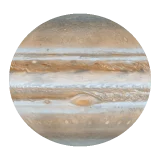
Jupiter's striped appearance is weather: cloud bands and storms moving above a deep atmosphere dominated by hydrogen and helium. There is no solid surface beneath the clouds on which to stand. [NASA]
Among worlds
Measurements & sourcesAll twelve worlds on fixed axes. Solid mark: Jupiter · open mark: comparison partner.
Mean diameter ↗
139,800 km1-bar reference level · settled
1,000 kmlogarithmic1,000,000 km
11 × Earth
Earth: 12,740 km · Physical surface · settled
Effective gravity ↗
23.12 m/s²1-bar reference level · settled
0 m/s²linear30 m/s²
2.36 × Earth
Earth: 9.780 m/s² · Physical surface · settled
Bulk density ↗
1,326 kg/m³1-bar reference level · derived
0 kg/m³linear6,000 kg/m³
0.241 × Earth
Earth: 5,513 kg/m³ · Physical surface · derived
Rotation duration ↗
9.925 hoursPrograde · sidereal, relative to the stars · settled
1 hourslogarithmic10,000 hours
0.415 × Earth
Earth: 23.93 hours · Prograde · sidereal, relative to the stars · settled
Rotation is a turn relative to the stars, not the interval between sunrises. Giant-planet size, density and gravity use the stated atmospheric reference level.
About Jupiter
Pressure and temperature increase inward, changing how the material behaves. The Great Red Spot is a long-lived storm within this moving atmosphere, while the planet's powerful magnetic environment extends far beyond its visible edge into the surrounding moon system. [NASA]
Below the cloud bands
Deep inside Jupiter, hydrogen is compressed into fluid and electrically conducting forms. Measurements from Juno suggest that heavier material is distributed through a broad, diffuse central region. The familiar outline in a photograph is therefore not a boundary between empty space and solid ground. [NASA]
A system of contrasting worlds
Io's volcanic landscape, Europa's icy shell, Ganymede and cratered Callisto belong to Jupiter's large satellite family. Faint rings add another component, made from small particles associated with the inner moons. Exploring the system reveals how different environments can develop around the same parent planet. [NASA]
More measurements
- Mass
- 1,898,000,000,000,000,000,000,000,000 kgbody mass · Not applicable · settled
- Sunlight at mean orbital distance
- 50.26 W/m²mean-orbit solar irradiance normal to the Sun's rays above any atmosphere · Not applicable · settled
- Mean orbital distance from Sun
- 5.203 AUheliocentric orbital semimajor axis from the J2000 mean orbital elements · Not applicable · settled
- Mean solar day
- 9.926 hoursmean solar day: the average interval from one local solar transit to the next · Not applicable · settled
- Temperature
- 163.1 Ktemperature at the 1-bar reference level · 1-bar reference level · settled
Compare all twelve worlds · data tables
| World | Value | Definition & state |
|---|---|---|
| Mercury | 4,879 km | Physical surface · settled |
| Venus | 12,100 km | Physical surface · settled |
| Earth | 12,740 km | Physical surface · settled |
| Mars | 6,779 km | Physical surface · settled |
| Jupiter | 139,800 km | 1-bar reference level · settled |
| Saturn | 116,500 km | 1-bar reference level · settled |
| Uranus | 50,720 km | 1-bar reference level · settled |
| Neptune | 49,240 km | 1-bar reference level · settled |
| Moon | 3,475 km | Physical surface · settled |
| Titan | 5,150 km | Physical surface · settled |
| Europa | 3,122 km | Physical surface · settled |
| Pluto | 2,377 km | Physical surface · settled |
| World | Value | Definition & state |
|---|---|---|
| Mercury | 3.70 m/s² | Physical surface · derived |
| Venus | 8.87 m/s² | Physical surface · derived |
| Earth | 9.780 m/s² | Physical surface · settled |
| Mars | 3.69 m/s² | Physical surface · settled |
| Jupiter | 23.12 m/s² | 1-bar reference level · settled |
| Saturn | 8.96 m/s² | 1-bar reference level · settled |
| Uranus | 8.69 m/s² | 1-bar reference level · settled |
| Neptune | 11.00 m/s² | 1-bar reference level · settled |
| Moon | 1.62 m/s² | Physical surface · settled |
| Titan | 1.354 m/s² | Physical surface · derived |
| Europa | 1.315 m/s² | Physical surface · derived |
| Pluto | 0.62 m/s² | Physical surface · derived |
| World | Value | Definition & state |
|---|---|---|
| Mercury | 5,429 kg/m³ | Physical surface · derived |
| Venus | 5,243 kg/m³ | Physical surface · derived |
| Earth | 5,513 kg/m³ | Physical surface · derived |
| Mars | 3,934 kg/m³ | Physical surface · derived |
| Jupiter | 1,326 kg/m³ | 1-bar reference level · derived |
| Saturn | 687.1 kg/m³ | 1-bar reference level · derived |
| Uranus | 1,270 kg/m³ | 1-bar reference level · derived |
| Neptune | 1,638 kg/m³ | 1-bar reference level · derived |
| Moon | 3,344 kg/m³ | Physical surface · derived |
| Titan | 1,881 kg/m³ | Physical surface · derived |
| Europa | 3,013 kg/m³ | Physical surface · derived |
| Pluto | 1,853 kg/m³ | Physical surface · derived |
| World | Value | Definition & state |
|---|---|---|
| Mercury | 1,408 hours | Prograde · sidereal, relative to the stars · settled |
| Venus | 5,832 hours | Retrograde · sidereal, relative to the stars · settled |
| Earth | 23.93 hours | Prograde · sidereal, relative to the stars · settled |
| Mars | 24.62 hours | Prograde · sidereal, relative to the stars · settled |
| Jupiter | 9.925 hours | Prograde · sidereal, relative to the stars · settled |
| Saturn | 10.66 hours | Prograde · sidereal, relative to the stars · settled |
| Uranus | 17.24 hours | Retrograde · sidereal, relative to the stars · settled |
| Neptune | 16.11 hours | Prograde · sidereal, relative to the stars · settled |
| Moon | 655.7 hours | Prograde · sidereal, relative to the stars · settled |
| Titan | 382.7 hours | Prograde · sidereal, relative to the stars · derived |
| Europa | 85.23 hours | Prograde · sidereal, relative to the stars · derived |
| Pluto | 153.3 hours | Retrograde · sidereal, relative to the stars · settled |
Measurements & sources · dataset 0.1
The comparison uses published values. Diameter is twice the resolved mean radius; rotation duration is the magnitude of the signed sidereal period. Numerical evidence below keeps the original radius and signed period.
Mean radius · diameter input
69,910 km · 1-bar reference level · settled
volumetric mean radius at the 1-bar level
Uncertainty: ±6 km. Not tied to a stated epoch.
- Planetary Physical Parameters · NASA Jet Propulsion Laboratory Solar System Dynamics. Retrieved 2026-08-30. Planet table, Jupiter row, Mean Radius: 69911 ± 6 km
jupiter:mean_radius:volumetric_mean_radius_at_1_bar:jpl_planetary_physical_parameters:0Effective gravity
23.12 m/s² · 1-bar reference level · settled
weight-equivalent gravity at the 1-bar level, at the equator
Uncertainty: Not stated. Not tied to a stated epoch.
- Jupiter Fact Sheet (Radio JOVE mirror of a superseded NSSDC edition) · NASA Goddard Space Flight Center Radio JOVE. Retrieved 2026-08-30. Jupiter/Earth Comparison, Gravity (eq., 1 bar) (m/s^2): Jupiter 23.12
- Planetary Physical Parameters · NASA Jet Propulsion Laboratory Solar System Dynamics. Retrieved 2026-08-30. Planet table, Jupiter row, Equatorial Gravity: 24.79 m s^-2
jupiter:gravity:effective_gravity_at_1_bar:nasa_gsfc_jupiter_fact_sheet:0Bulk density
1,326 kg/m³ · 1-bar reference level · derived
bulk mean density within the 1-bar reference level
Uncertainty: ±0.347 kg/m³. Not tied to a stated epoch.
Density from mass and mean radius. Inputs: Mass: 1,898,000,000,000,000,000,000,000,000 kg; Mean radius: 69,910,000 m.
- Planetary Physical Parameters · NASA Jet Propulsion Laboratory Solar System Dynamics. Retrieved 2026-08-30. Planet table, Jupiter row, Mass: 1898.125 ± 0.088 ×10^24 kg; Planet table, Jupiter row, Mean Radius: 69911 ± 6 km
jupiter:density:bulk_mean_density_at_1_bar:density_from_mass_radius:0Rotation duration
9.925 hours · Not applicable · settled
sidereal rotation period
Uncertainty: Not stated. Not tied to a stated epoch.
- Planetary Physical Parameters · NASA Jet Propulsion Laboratory Solar System Dynamics. Retrieved 2026-08-30. Planet table, Jupiter row, Sidereal Rotation Period: 0.41354 d
jupiter:rotation_period:sidereal_rotation_period:jpl_planetary_physical_parameters:0Mass
1,898,000,000,000,000,000,000,000,000 kg · Not applicable · settled
body mass
Uncertainty: ±88,000,000,000,000,000,000,000 kg. Not tied to a stated epoch.
- Planetary Physical Parameters · NASA Jet Propulsion Laboratory Solar System Dynamics. Retrieved 2026-08-30. Planet table, Jupiter row, Mass: 1898.125 ± 0.088 ×10^24 kg
jupiter:mass:body_mass:jpl_planetary_physical_parameters:0Sunlight at mean orbital distance
50.26 W/m² · Not applicable · settled
mean-orbit solar irradiance normal to the Sun's rays above any atmosphere
Uncertainty: Not stated. Not tied to a stated epoch.
- Jupiter Fact Sheet (2024-10-04 NASA NSSDC archive capture) · NASA Goddard Space Flight Center National Space Science Data Center. Retrieved 2026-09-02. Jupiter/Earth comparison table, Solar irradiance: Jupiter 50.26 W/m²
jupiter:solar_irradiance:mean_orbit_solar_irradiance:nasa_nssdc_jupiter_fact_sheet_archive:0Mean orbital distance from Sun
5.203 AU · Not applicable · settled
heliocentric orbital semimajor axis from the J2000 mean orbital elements
Uncertainty: Not stated. Not tied to a stated epoch.
- Jupiter Fact Sheet (2024-10-04 NASA NSSDC archive capture) · NASA Goddard Space Flight Center National Space Science Data Center. Retrieved 2026-09-02. Jupiter Mean Orbital Elements (J2000), Semimajor axis (AU): 5.20336301
jupiter:heliocentric_distance:heliocentric_orbital_semimajor_axis:nasa_nssdc_jupiter_fact_sheet_archive:0Mean solar day
9.926 hours · Not applicable · settled
mean solar day: the average interval from one local solar transit to the next
Uncertainty: Not stated. Not tied to a stated epoch.
- Jupiter Fact Sheet (2024-10-04 NASA NSSDC archive capture) · NASA Goddard Space Flight Center National Space Science Data Center. Retrieved 2026-09-02. Jupiter/Earth comparison table, Length of day: Jupiter 9.9259 h
- Planetary Physical Parameters · NASA Jet Propulsion Laboratory Solar System Dynamics. Retrieved 2026-08-30. Planet table, Jupiter row, Sidereal Rotation Period: 0.41354 d
jupiter:day_length:mean_solar_day:nasa_nssdc_jupiter_fact_sheet_archive:0Temperature
163.1 K · 1-bar reference level · settled
temperature at the 1-bar reference level
Uncertainty: Not stated. Not tied to a stated epoch.
- Solar System Temperatures · National Aeronautics and Space Administration. Retrieved 2026-08-30. Mean temperatures on each planet: Jupiter -166°F (-110°C); giant values are at Earth sea-level pressure
jupiter:temperature:temperature_at_1_bar:nasa_solar_system_temperatures:0Portrait
An unlit render of a global map onto Jupiter's measured ellipsoid, seen equator-on. It is a model, not a photograph, and shows no phase or terminator. Rendered from Jupiter cloud map — Solar System Scope, CC BY 4.0, from NASA imagery.
Original narrative edition 2026-10-23; sources reviewed 2026-09-11. Paragraph citations refer to narrative sources, not the numeric measurements.
Cite this page: Yale Thomas. Worlds. “Jupiter overview” View: default. Dataset 0.1. https://yalethom.as/worlds/info/jupiter/. Accessed [the date you viewed this page]. Narrative edition 2026-10-23.