Moon of Earth
Moon
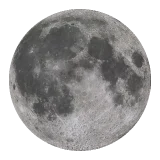
The Moon is a rocky world whose surface preserves a long record of impacts and ancient volcanism. Bright highlands contrast with darker plains formed when lava filled large basins. [NASA]
Among worlds
Measurements & sourcesAll twelve worlds on fixed axes. Solid mark: Moon · open mark: comparison partner.
Mean diameter ↗
3,475 kmPhysical surface · settled
1,000 kmlogarithmic1,000,000 km
0.273 × Earth
Earth: 12,740 km · Physical surface · settled
Effective gravity ↗
1.62 m/s²Physical surface · settled
0 m/s²linear30 m/s²
0.166 × Earth
Earth: 9.780 m/s² · Physical surface · settled
Bulk density ↗
3,344 kg/m³Physical surface · derived
0 kg/m³linear6,000 kg/m³
0.607 × Earth
Earth: 5,513 kg/m³ · Physical surface · derived
Rotation duration ↗
655.7 hoursPrograde · sidereal, relative to the stars · settled
1 hourslogarithmic10,000 hours
27.4 × Earth
Earth: 23.93 hours · Prograde · sidereal, relative to the stars · settled
Rotation is a turn relative to the stars, not the interval between sunrises. Giant-planet size, density and gravity use the stated atmospheric reference level.
About the Moon
With only a very sparse atmosphere, exposed rock is repeatedly struck and broken into rubble and fine dust. The same hemisphere generally faces Earth, but the far side is not permanently dark: sunlight moves across both sides as the Moon travels around us. [NASA]
Dust over an ancient landscape
The loose surface material is called regolith. It includes fragments produced by repeated impacts, from rocks to fine powder. Craters overlap older features, while the dark volcanic plains record a different part of lunar history. Samples returned to Earth let researchers study that history directly. [NASA]
Sunlight, shadow and ice
The exposed surface experiences large temperature changes between daylight and darkness. Near the poles, some crater interiors remain in permanent shadow and contain water ice. These local environments differ markedly from sunlit terrain, which is why a single temperature cannot describe every place on the Moon. [NASA]
More measurements
- Mass
- 73,460,000,000,000,000,000,000 kgbody mass · Not applicable · derived
- Sunlight at mean orbital distance
- 1,361 W/m²mean-orbit solar irradiance normal to the Sun's rays above any atmosphere · Not applicable · derived · Inherited from Earth's mean orbit
- Mean orbital distance from Sun
- 1.000 AUheliocentric orbital semimajor axis from the J2000 mean orbital elements · Not applicable · derived · Inherited from Earth's mean orbit
- Mean solar day
- 708.7 hoursmean solar day: the average interval from one local solar transit to the next · Not applicable · settled
- Temperature · context only
- 215.5 Kdiurnal mean bolometric surface temperature at the equator · Physical surface · settled
- Temperature
- Not established in this datasetmean temperature at the physical surface · Physical surface · unknown
Compare all twelve worlds · data tables
| World | Value | Definition & state |
|---|---|---|
| Mercury | 4,879 km | Physical surface · settled |
| Venus | 12,100 km | Physical surface · settled |
| Earth | 12,740 km | Physical surface · settled |
| Mars | 6,779 km | Physical surface · settled |
| Jupiter | 139,800 km | 1-bar reference level · settled |
| Saturn | 116,500 km | 1-bar reference level · settled |
| Uranus | 50,720 km | 1-bar reference level · settled |
| Neptune | 49,240 km | 1-bar reference level · settled |
| Moon | 3,475 km | Physical surface · settled |
| Titan | 5,150 km | Physical surface · settled |
| Europa | 3,122 km | Physical surface · settled |
| Pluto | 2,377 km | Physical surface · settled |
| World | Value | Definition & state |
|---|---|---|
| Mercury | 3.70 m/s² | Physical surface · derived |
| Venus | 8.87 m/s² | Physical surface · derived |
| Earth | 9.780 m/s² | Physical surface · settled |
| Mars | 3.69 m/s² | Physical surface · settled |
| Jupiter | 23.12 m/s² | 1-bar reference level · settled |
| Saturn | 8.96 m/s² | 1-bar reference level · settled |
| Uranus | 8.69 m/s² | 1-bar reference level · settled |
| Neptune | 11.00 m/s² | 1-bar reference level · settled |
| Moon | 1.62 m/s² | Physical surface · settled |
| Titan | 1.354 m/s² | Physical surface · derived |
| Europa | 1.315 m/s² | Physical surface · derived |
| Pluto | 0.62 m/s² | Physical surface · derived |
| World | Value | Definition & state |
|---|---|---|
| Mercury | 5,429 kg/m³ | Physical surface · derived |
| Venus | 5,243 kg/m³ | Physical surface · derived |
| Earth | 5,513 kg/m³ | Physical surface · derived |
| Mars | 3,934 kg/m³ | Physical surface · derived |
| Jupiter | 1,326 kg/m³ | 1-bar reference level · derived |
| Saturn | 687.1 kg/m³ | 1-bar reference level · derived |
| Uranus | 1,270 kg/m³ | 1-bar reference level · derived |
| Neptune | 1,638 kg/m³ | 1-bar reference level · derived |
| Moon | 3,344 kg/m³ | Physical surface · derived |
| Titan | 1,881 kg/m³ | Physical surface · derived |
| Europa | 3,013 kg/m³ | Physical surface · derived |
| Pluto | 1,853 kg/m³ | Physical surface · derived |
| World | Value | Definition & state |
|---|---|---|
| Mercury | 1,408 hours | Prograde · sidereal, relative to the stars · settled |
| Venus | 5,832 hours | Retrograde · sidereal, relative to the stars · settled |
| Earth | 23.93 hours | Prograde · sidereal, relative to the stars · settled |
| Mars | 24.62 hours | Prograde · sidereal, relative to the stars · settled |
| Jupiter | 9.925 hours | Prograde · sidereal, relative to the stars · settled |
| Saturn | 10.66 hours | Prograde · sidereal, relative to the stars · settled |
| Uranus | 17.24 hours | Retrograde · sidereal, relative to the stars · settled |
| Neptune | 16.11 hours | Prograde · sidereal, relative to the stars · settled |
| Moon | 655.7 hours | Prograde · sidereal, relative to the stars · settled |
| Titan | 382.7 hours | Prograde · sidereal, relative to the stars · derived |
| Europa | 85.23 hours | Prograde · sidereal, relative to the stars · derived |
| Pluto | 153.3 hours | Retrograde · sidereal, relative to the stars · settled |
Measurements & sources · dataset 0.1
The comparison uses published values. Diameter is twice the resolved mean radius; rotation duration is the magnitude of the signed sidereal period. Numerical evidence below keeps the original radius and signed period.
Mean radius · diameter input
1,737 km · Physical surface · settled
volumetric mean radius of the physical surface
Uncertainty: ±0.1 km. Not tied to a stated epoch.
- Planetary Satellite Physical Parameters · NASA Jet Propulsion Laboratory Solar System Dynamics. Retrieved 2026-08-30. Satellites of Earth table, Moon row, Mean Radius: 1737.4 ± 0.1 km [IAU reference 1]
moon:mean_radius:volumetric_mean_surface_radius:jpl_satellite_physical_parameters:0Effective gravity
1.62 m/s² · Physical surface · settled
weight-equivalent gravity at the physical surface, at the equator
Uncertainty: Not stated. Not tied to a stated epoch.
- Moon Fact Sheet (2024-10-03 NASA NSSDC archive capture) · NASA Goddard Space Flight Center National Space Science Data Center. Retrieved 2026-08-30. Moon/Earth comparison table, Surface acceleration (m/s²): Moon 1.62; fact-sheet notes define this row as rotation-inclusive
- Planetary Satellite Physical Parameters · NASA Jet Propulsion Laboratory Solar System Dynamics. Retrieved 2026-08-30. Satellites of Earth table, Moon row, GM: 4902.800 ± 0.001 km^3/s^2 [DE440]; Satellites of Earth table, Moon row, Mean Radius: 1737.4 ± 0.1 km [IAU reference 1]
moon:gravity:effective_gravity_at_surface:nasa_nssdc_moon_fact_sheet_archive:0Bulk density
3,344 kg/m³ · Physical surface · derived
bulk mean density within the physical surface
Uncertainty: ±0.582 kg/m³. Not tied to a stated epoch.
Density from mass and mean radius. Inputs: Mass: 73,460,000,000,000,000,000,000 kg; Mean radius: 1,737,000 m.
- Planetary Satellite Physical Parameters · NASA Jet Propulsion Laboratory Solar System Dynamics. Retrieved 2026-08-30. Satellites of Earth table, Moon row, GM: 4902.800 ± 0.001 km^3/s^2 [DE440]; Satellites of Earth table, Moon row, Mean Radius: 1737.4 ± 0.1 km [IAU reference 1]
- CODATA Recommended Values of the Fundamental Physical Constants: 2018 · National Institute of Standards and Technology. Retrieved 2026-08-30.
moon:density:bulk_mean_density_at_surface:density_from_mass_radius:0Rotation duration
655.7 hours · Not applicable · settled
sidereal rotation period
Uncertainty: Not stated. Not tied to a stated epoch.
- Moon Fact Sheet (2024-10-03 NASA NSSDC archive capture) · NASA Goddard Space Flight Center National Space Science Data Center. Retrieved 2026-08-30. Moon/Earth comparison table, Sidereal rotation period: Moon 655.720 h
moon:rotation_period:sidereal_rotation_period:nasa_nssdc_moon_fact_sheet_archive:0Mass
73,460,000,000,000,000,000,000 kg · Not applicable · derived
body mass
Uncertainty: ±1,650,000,000,000,000,000 kg. Not tied to a stated epoch.
Mass from gravitational parameter. Inputs: Standard gravitational parameter: 4,903,000,000,000 m³/s².
- Planetary Satellite Physical Parameters · NASA Jet Propulsion Laboratory Solar System Dynamics. Retrieved 2026-08-30. Satellites of Earth table, Moon row, GM: 4902.800 ± 0.001 km^3/s^2 [DE440]
- CODATA Recommended Values of the Fundamental Physical Constants: 2018 · National Institute of Standards and Technology. Retrieved 2026-08-30.
moon:mass:body_mass:mass_from_gravitational_parameter:0Sunlight at mean orbital distance
1,361 W/m² · Not applicable · derived
mean-orbit solar irradiance normal to the Sun's rays above any atmosphere
Uncertainty: Not stated. Not tied to a stated epoch.
Inherited from Earth's mean orbit.
Solar irradiance inherited from the parent system. Inputs: Solar irradiance: 1,361 W/m².
- Earth Fact Sheet (2024-11-16 NASA NSSDC archive capture) · NASA Goddard Space Flight Center National Space Science Data Center. Retrieved 2026-09-02. Earth Fact Sheet, Bulk parameters, Solar irradiance: 1361.0 W/m²
moon:solar_irradiance:mean_orbit_solar_irradiance:solar_irradiance_from_parent_system:0Mean orbital distance from Sun
1.000 AU · Not applicable · derived
heliocentric orbital semimajor axis from the J2000 mean orbital elements
Uncertainty: Not stated. Not tied to a stated epoch.
Inherited from Earth's mean orbit.
Distance from the Sun inherited from the parent system. Inputs: Distance from the Sun: 1.000 AU.
- Earth Fact Sheet (2024-11-16 NASA NSSDC archive capture) · NASA Goddard Space Flight Center National Space Science Data Center. Retrieved 2026-09-02. Earth Mean Orbital Elements (J2000), Semimajor axis (AU): 1.00000011
moon:heliocentric_distance:heliocentric_orbital_semimajor_axis:heliocentric_distance_from_parent_system:0Mean solar day
708.7 hours · Not applicable · settled
mean solar day: the average interval from one local solar transit to the next
Uncertainty: Not stated. Not tied to a stated epoch.
- Moon Fact Sheet (2024-10-03 NASA NSSDC archive capture) · NASA Goddard Space Flight Center National Space Science Data Center. Retrieved 2026-08-30. Moon/Earth comparison table, Sidereal rotation period: Moon 655.720 h; Moon/Earth comparison table, Synodic period: Moon 29.53 d
moon:day_length:mean_solar_day:nasa_nssdc_moon_fact_sheet_archive:0Temperature · context only
215.5 K · Physical surface · settled
diurnal mean bolometric surface temperature at the equator
Uncertainty: Not stated. 2009-07-05–2015-04-01.
- The global surface temperatures of the Moon as measured by the Diviner Lunar Radiometer Experiment · Icarus. Retrieved 2026-08-30. Section 4.4 and Figure 19: mean temperature at the equator is 215.5 K
moon:temperature:equatorial_mean_bolometric_surface_temperature:diviner_lunar_surface_temperatures_2017:0Temperature
Not established in this dataset · Physical surface · unknown
mean temperature at the physical surface
Uncertainty: Not stated. Not tied to a stated epoch.
- The global surface temperatures of the Moon as measured by the Diviner Lunar Radiometer Experiment · Icarus. Retrieved 2026-08-30. Section 4.4 and Figure 19: mean temperature at the equator is 215.5 K
moon:temperature:mean_surface_temperature:unknown:0Portrait
An unlit render of a global map onto Moon's measured ellipsoid, seen equator-on. It is a model, not a photograph, and shows no phase or terminator. Rendered from Moon global map — Solar System Scope, CC BY 4.0, from NASA/LRO imagery.
Original narrative edition 2026-10-23; sources reviewed 2026-09-11. Paragraph citations refer to narrative sources, not the numeric measurements.
Cite this page: Yale Thomas. Worlds. “Moon overview” View: default. Dataset 0.1. https://yalethom.as/worlds/info/moon/. Accessed [the date you viewed this page]. Narrative edition 2026-10-23.