Rocky planet
Mercury
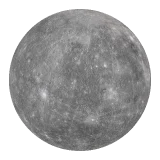
Mercury is a rocky world of exposed craters, broad plains and steep scarps. Its resemblance to the Moon hides an unusually large metallic core beneath a relatively thin rocky exterior. [NASA]
Among worlds
Measurements & sourcesAll twelve worlds on fixed axes. Solid mark: Mercury · open mark: comparison partner.
Mean diameter ↗
4,879 kmPhysical surface · settled
1,000 kmlogarithmic1,000,000 km
0.383 × Earth
Earth: 12,740 km · Physical surface · settled
Effective gravity ↗
3.70 m/s²Physical surface · derived
0 m/s²linear30 m/s²
0.378 × Earth
Earth: 9.780 m/s² · Physical surface · settled
Bulk density ↗
5,429 kg/m³Physical surface · derived
0 kg/m³linear6,000 kg/m³
0.985 × Earth
Earth: 5,513 kg/m³ · Physical surface · derived
Rotation duration ↗
1,408 hoursPrograde · sidereal, relative to the stars · settled
1 hourslogarithmic10,000 hours
58.8 × Earth
Earth: 23.93 hours · Prograde · sidereal, relative to the stars · settled
Rotation is a turn relative to the stars, not the interval between sunrises. Giant-planet size, density and gravity use the stated atmospheric reference level.
About Mercury
Close to the Sun, the ground heats fiercely in daylight and cools dramatically at night. A sparse exosphere offers little insulation. This is a place where the contrast between sunlight and shadow matters as much as the average temperature. [NASA]
A surface that keeps its scars
Impacts have excavated enormous basins and scattered bright rays of crushed rock. Elsewhere, long cliffs record the planet contracting as its interior cooled. With little atmosphere to weather the landscape, the surface preserves a visible record of collisions and changes deep inside the planet. [NASA]
An unfamiliar sunrise
Mercury's slow spin and changing speed around its elliptical orbit produce an unusual apparent motion of the Sun. From some locations, sunrise can briefly reverse before continuing. Deep polar craters offer another contrast: their permanently shadowed interiors can remain cold enough to preserve ice despite the intense sunlight nearby. [NASA]
More measurements
- Mass
- 330,100,000,000,000,000,000,000 kgbody mass · Not applicable · settled
- Sunlight at mean orbital distance
- 9,083 W/m²mean-orbit solar irradiance normal to the Sun's rays above any atmosphere · Not applicable · settled
- Mean orbital distance from Sun
- 0.3871 AUheliocentric orbital semimajor axis from the J2000 mean orbital elements · Not applicable · settled
- Mean solar day
- 4,223 hoursmean solar day: the average interval from one local solar transit to the next · Not applicable · settled
- Temperature
- 440.2 Kmean temperature at the physical surface · Physical surface · settled
Compare all twelve worlds · data tables
| World | Value | Definition & state |
|---|---|---|
| Mercury | 4,879 km | Physical surface · settled |
| Venus | 12,100 km | Physical surface · settled |
| Earth | 12,740 km | Physical surface · settled |
| Mars | 6,779 km | Physical surface · settled |
| Jupiter | 139,800 km | 1-bar reference level · settled |
| Saturn | 116,500 km | 1-bar reference level · settled |
| Uranus | 50,720 km | 1-bar reference level · settled |
| Neptune | 49,240 km | 1-bar reference level · settled |
| Moon | 3,475 km | Physical surface · settled |
| Titan | 5,150 km | Physical surface · settled |
| Europa | 3,122 km | Physical surface · settled |
| Pluto | 2,377 km | Physical surface · settled |
| World | Value | Definition & state |
|---|---|---|
| Mercury | 3.70 m/s² | Physical surface · derived |
| Venus | 8.87 m/s² | Physical surface · derived |
| Earth | 9.780 m/s² | Physical surface · settled |
| Mars | 3.69 m/s² | Physical surface · settled |
| Jupiter | 23.12 m/s² | 1-bar reference level · settled |
| Saturn | 8.96 m/s² | 1-bar reference level · settled |
| Uranus | 8.69 m/s² | 1-bar reference level · settled |
| Neptune | 11.00 m/s² | 1-bar reference level · settled |
| Moon | 1.62 m/s² | Physical surface · settled |
| Titan | 1.354 m/s² | Physical surface · derived |
| Europa | 1.315 m/s² | Physical surface · derived |
| Pluto | 0.62 m/s² | Physical surface · derived |
| World | Value | Definition & state |
|---|---|---|
| Mercury | 5,429 kg/m³ | Physical surface · derived |
| Venus | 5,243 kg/m³ | Physical surface · derived |
| Earth | 5,513 kg/m³ | Physical surface · derived |
| Mars | 3,934 kg/m³ | Physical surface · derived |
| Jupiter | 1,326 kg/m³ | 1-bar reference level · derived |
| Saturn | 687.1 kg/m³ | 1-bar reference level · derived |
| Uranus | 1,270 kg/m³ | 1-bar reference level · derived |
| Neptune | 1,638 kg/m³ | 1-bar reference level · derived |
| Moon | 3,344 kg/m³ | Physical surface · derived |
| Titan | 1,881 kg/m³ | Physical surface · derived |
| Europa | 3,013 kg/m³ | Physical surface · derived |
| Pluto | 1,853 kg/m³ | Physical surface · derived |
| World | Value | Definition & state |
|---|---|---|
| Mercury | 1,408 hours | Prograde · sidereal, relative to the stars · settled |
| Venus | 5,832 hours | Retrograde · sidereal, relative to the stars · settled |
| Earth | 23.93 hours | Prograde · sidereal, relative to the stars · settled |
| Mars | 24.62 hours | Prograde · sidereal, relative to the stars · settled |
| Jupiter | 9.925 hours | Prograde · sidereal, relative to the stars · settled |
| Saturn | 10.66 hours | Prograde · sidereal, relative to the stars · settled |
| Uranus | 17.24 hours | Retrograde · sidereal, relative to the stars · settled |
| Neptune | 16.11 hours | Prograde · sidereal, relative to the stars · settled |
| Moon | 655.7 hours | Prograde · sidereal, relative to the stars · settled |
| Titan | 382.7 hours | Prograde · sidereal, relative to the stars · derived |
| Europa | 85.23 hours | Prograde · sidereal, relative to the stars · derived |
| Pluto | 153.3 hours | Retrograde · sidereal, relative to the stars · settled |
Measurements & sources · dataset 0.1
The comparison uses published values. Diameter is twice the resolved mean radius; rotation duration is the magnitude of the signed sidereal period. Numerical evidence below keeps the original radius and signed period.
Mean radius · diameter input
2,439 km · Physical surface · settled
volumetric mean radius of the physical surface
Uncertainty: ±0.1 km. Not tied to a stated epoch.
- Planetary Physical Parameters · NASA Jet Propulsion Laboratory Solar System Dynamics. Retrieved 2026-08-30. Planet table, Mercury row, Mean Radius: 2439.4 ± 0.1 km
mercury:mean_radius:volumetric_mean_surface_radius:jpl_planetary_physical_parameters:0Effective gravity
3.70 m/s² · Physical surface · derived
weight-equivalent gravity at the physical surface, at the equator
Uncertainty: ±0.000277 m/s². Not tied to a stated epoch.
Gravity from mass and equatorial radius. Inputs: Mass: 330,100,000,000,000,000,000,000 kg; Equatorial radius: 2,441,000 m.
- Planetary Physical Parameters · NASA Jet Propulsion Laboratory Solar System Dynamics. Retrieved 2026-08-30. Planet table, Mercury row, Equatorial Gravity: 3.70 m s^-2; Planet table, Mercury row, Mass: 0.330103 ± 0.000021 ×10^24 kg
- Report of the IAU Working Group on Cartographic Coordinates and Rotational Elements: 2015 · International Astronomical Union Working Group on Cartographic Coordinates and Rotational Elements. Retrieved 2026-08-30. Table 4, Mercury: long equatorial axis 2440.53 ± 0.04 km
- CODATA Recommended Values of the Fundamental Physical Constants: 2018 · National Institute of Standards and Technology. Retrieved 2026-08-30.
mercury:gravity:effective_gravity_at_surface:gravity_from_mass_equatorial_radius:0Bulk density
5,429 kg/m³ · Physical surface · derived
bulk mean density within the physical surface
Uncertainty: ±0.752 kg/m³. Not tied to a stated epoch.
Density from mass and mean radius. Inputs: Mass: 330,100,000,000,000,000,000,000 kg; Mean radius: 2,439,000 m.
- Planetary Physical Parameters · NASA Jet Propulsion Laboratory Solar System Dynamics. Retrieved 2026-08-30. Planet table, Mercury row, Mass: 0.330103 ± 0.000021 ×10^24 kg; Planet table, Mercury row, Mean Radius: 2439.4 ± 0.1 km
mercury:density:bulk_mean_density_at_surface:density_from_mass_radius:0Rotation duration
1,408 hours · Not applicable · settled
sidereal rotation period
Uncertainty: Not stated. Not tied to a stated epoch.
- Planetary Physical Parameters · NASA Jet Propulsion Laboratory Solar System Dynamics. Retrieved 2026-08-30. Planet table, Mercury row, Sidereal Rotation Period: 58.6462 d
mercury:rotation_period:sidereal_rotation_period:jpl_planetary_physical_parameters:0Mass
330,100,000,000,000,000,000,000 kg · Not applicable · settled
body mass
Uncertainty: ±21,000,000,000,000,000,000 kg. Not tied to a stated epoch.
- Planetary Physical Parameters · NASA Jet Propulsion Laboratory Solar System Dynamics. Retrieved 2026-08-30. Planet table, Mercury row, Mass: 0.330103 ± 0.000021 ×10^24 kg
mercury:mass:body_mass:jpl_planetary_physical_parameters:0Sunlight at mean orbital distance
9,083 W/m² · Not applicable · settled
mean-orbit solar irradiance normal to the Sun's rays above any atmosphere
Uncertainty: Not stated. Not tied to a stated epoch.
- Mercury Fact Sheet (2024-02-04 NASA NSSDC archive capture) · NASA Goddard Space Flight Center National Space Science Data Center. Retrieved 2026-09-02. Mercury/Earth comparison table, Solar irradiance: Mercury 9082.7 W/m²
mercury:solar_irradiance:mean_orbit_solar_irradiance:nasa_nssdc_mercury_fact_sheet_archive:0Mean orbital distance from Sun
0.3871 AU · Not applicable · settled
heliocentric orbital semimajor axis from the J2000 mean orbital elements
Uncertainty: Not stated. Not tied to a stated epoch.
- Mercury Fact Sheet (2024-02-04 NASA NSSDC archive capture) · NASA Goddard Space Flight Center National Space Science Data Center. Retrieved 2026-09-02. Mercury Mean Orbital Elements (J2000), Semimajor axis (AU): 0.38709893
mercury:heliocentric_distance:heliocentric_orbital_semimajor_axis:nasa_nssdc_mercury_fact_sheet_archive:0Mean solar day
4,223 hours · Not applicable · settled
mean solar day: the average interval from one local solar transit to the next
Uncertainty: Not stated. Not tied to a stated epoch.
- Mercury Fact Sheet (2024-02-04 NASA NSSDC archive capture) · NASA Goddard Space Flight Center National Space Science Data Center. Retrieved 2026-09-02. Mercury/Earth comparison table, Length of day: Mercury 4222.6 h
- Planetary Physical Parameters · NASA Jet Propulsion Laboratory Solar System Dynamics. Retrieved 2026-08-30. Planet table, Mercury row, Sidereal Rotation Period: 58.6462 d
mercury:day_length:mean_solar_day:nasa_nssdc_mercury_fact_sheet_archive:0Temperature
440.2 K · Physical surface · settled
mean temperature at the physical surface
Uncertainty: Not stated. Not tied to a stated epoch.
- Solar System Temperatures · National Aeronautics and Space Administration. Retrieved 2026-08-30. Mean temperatures on each planet: Mercury 333°F (167°C)
mercury:temperature:mean_surface_temperature:nasa_solar_system_temperatures:0Portrait
An unlit render of a global map onto Mercury's measured ellipsoid, seen equator-on. It is a model, not a photograph, and shows no phase or terminator. Rendered from Mercury global map — Solar System Scope, CC BY 4.0, from NASA/MESSENGER imagery.
Original narrative edition 2026-10-23; sources reviewed 2026-09-11. Paragraph citations refer to narrative sources, not the numeric measurements.
Cite this page: Yale Thomas. Worlds. “Mercury overview” View: default. Dataset 0.1. https://yalethom.as/worlds/info/mercury/. Accessed [the date you viewed this page]. Narrative edition 2026-10-23.